What’s In a Name? Part 1

Names have been in existence ever since God created humans. God gave Adam the first name, meaning “formed of the earth”. Names are an integral part of who we are. Although we are all unique anyway, names give us a tangible way to distinguish one another.

Not only are the names that we have now meaningful, but we are told in Revelation 2:17 that every believer is going to receive a new name that will be written in a white stone that no one will know except the one who receives it. This promise shows us just how loved and special we are to the God who created us.

Both religion and culture have influenced the meaning of names. In ancient times, people were generally given just one name, and it was often related to a circumstance surrounding the child’s birth (“Moses” means “drawn from the water”), or connected with a promise (“Isaac” means “laughter”, because Abraham and Sarah found joy and laughter when they had a son in their old age). Later in history, second names were given to demonstrate a person’s identification with a particular family or clan (Gaius Julius Caesar), or even with a father (“Simon bar-Jonah” means “the son of Jonah”).

Around 1100 AD, additional names became more common in Western Civilization. These surnames were originally for the noble class (thus, “sir” names), but in 1465 King Edward V of England required that surnames be adopted by everybody for identification purposes. These were to reflect a person’s identity in some way. They often represented their work (Miller, Baker). Other names were even formed by adding “son” to the father’s name (Johnson, Anderson).

Middle names were not used until the 18th century, and these were added to further distinguish a person or as a way of honoring deceased persons. These have become more important as the population has continued to grow.

In modern days, the names of children are often selected on the basis of familiarity and popularity. However, some parents still name their children after some specific characteristic or place, or to commemorate someone or something.

Generally, names are still chosen on the merits of their positive implications with the expectation and hope that the child will exhibit that quality (Cady means “pure”). Christian parents often look in the Bible for names that will seemingly fit the goals that they have for the child or for the circumstances related to the child (Matthew means “a gift from God”, Samuel means “God has heard”, and Joshua means “God is my Salvation”).

Names are wonderful gifts! They are “a celebration not only of our humanity, but also a reminder of our individuality- that we are uniquely made in the image of God” (The Name Book by Dorothy Astonia, page 9).


Heroes of the Faith

Philippians 4:8 -“Finally, brethren, whatsoever things are true, whatsoever things are honest, whatsoever things are just, whatsoever things are pure, whatsoever things are lovely, whatsoever things are of good report; if there be any virtue, and if there be any praise, think on these things.”

During these times of uncertainty, when it’s hard to find a lot of things that are true, honest, just, pure, lovely, of good report, virtuous, or praiseworthy (except for Jesus Christ and the Word of God), I have found that “heroes of the faith” biographies and autobiographies are very positive and encouraging reading material. Of Course, some of the best heroes of the faith are found in the Bible, like Daniel, David, Samuel, Esther, the Apostle Paul, etc.

First, begin by brainstorming who some of your own heroes of the faith are. After you come up with a list of them, check your bookshelves to see which of your heroes that you own books about. If you don’t own books about any of them, you can always see if you can find some on your kindle, borrow some of them from a friend (do you have any friends who have been homeschooling their children for very long? They are apt to have some), or it would be worth it to order a couple of them from Thrift Books or another book company. It’s worth it to read fascinating stories about ordinary people who God used in extraordinary ways. Thinking on these things is faith-building, since it helps us to realize that God has a special plan and purpose for all of “His children”.

Most of my heroes are missionaries, since I have always loved stories of people who gave up their worldly comforts to go to faraway places where many of the people have either never had the opportunity to hear the good news of Jesus Christ, or the good news has been lost or forgotten through the years due to sin. Well, when you think of it, all Christians are supposed to be “missionaries” anyway wherever we are.

The following is a list of my top ten heroes of the faith, and a very short summary of their life:

George Mueller, who had been a rebel and thief during the first part of his life, later founded and ran orphanages for homeless children in London during the 1800’s. He believed the promises of the Bible, and saw God provide the many things needed to care for the many children in answer to prayer.

Hudson Taylor was a medical missionary to China, who had heard how God provided miraculously for George Mueller’s ministry, and he, too, decided to trust God for all his provisions. He chose to live a very simple life like the people that he was ministering to, and founded China Inland Missons.

Amy Carmichael was a missionary to India in the 1800’s who saved many little girls from the abuse of being “temple girls” dedicated to Hindu gods.

Corrie Ten Boom and her family hid Jews during the WWll Holocaust, helping them to escape the ovens of the concentration camps. She and some of her family members were eventually caught and sent to the camps themselves. After the war ended, she travelled around the world sharing her triumphant testimony.

John Bunyan was imprisoned for his faith in the 1600’s for preaching without a license. During his 12 or so years in prison, he wrote the famous classic, Pilgrim’s Progress.

William Tyndale risked his life during the 1500’s to translate the Bible into English, so that even the common people could read it. In many places at that time, it was only written and read in Latin by the clergy.

Harriet Tubman, nicknamed “Moses”, escaped from slavery in the South, and then returned time and again to the South to rescue over 300 other slaves, helping them get to the North where they were free.

Mary Slessor was a missionary to Africa in the 1800’s, who courageously faced all kinds of dangers while sharing the gospel. One of her greatest achievements was helping to stop the killing of twin babies, which was due to a held superstition of the people with whom she worked.

Originally from one of the indigenous tribal groups in India, Rochunga Pudaite had the privilege and hard work of translating the Bible into the language of his people. The movie, Beyond the Next Mountain, tells the story of his life.

David Wilkerson was a small-town preacher who believed in a big God. He went to NYC in the late 1950’s to share Christ with young people who were caught up in gangs, crime, and drugs. He founded Teen Challenge, which later became World Challenge. Nicki Cruz was one of the gang members that came to the Lord through David Wilkerson’s work there. (The Cross and the Switchblade and Run Baby Run are two great books about them).

I feel so privileged to have personally met two of my “heroes”- Rochunga Pudaite and David Wilkerson. At the time that I am writing this blog post, I am rereading The Cross and the Switchblade, and praying that God will lead me to minister to others in a similar way.

No chocolate “Chocolate” Pudding

“Therefore, whether you eat or drink, or whatever you do, do all to the glory of God.” (1 Corinthians 10:31)

My favorite healthy dessert recipe comes from the book Nutrition 101: Choose Life! by Debra Raybern, Sera Johnson, Laura Hopkins, and Karen Hopkins (page 109).

This recipe uses raw blue agave nectar, in place of the more common mucus-producing sugar; It contains carob as an alternative to chocolate, which also can be mucus-producing; The ripe avocado in it provides a smooth and creamy texture for the pudding, and it replaces the mucus-forming cream and milk that are found in many puddings.

“Raw blue agave nectar is an organic liquid sweetener make from the Mexican blue agave plant (tequilana) that is sweeter than sugar. It has a low glycemic index of just 11 compared to honey at 55 and table sugar at 68.This is an ideal choice for anyone wanting to maintain healthy blood sugar levels and still enjoy a sweet treat once in a while.” (page 363)

“Carob is a tropical pod that contains a sweet, edible pulp and inedible seeds. After drying, the pulp is roasted and ground into a powder that resembles cocoa powder, but does not have the same flavor and texture of chocolate.” Carob powder is higher in carbohydrates and has more calories that cocoa powder, but it is caffeine-free and contains three times as much calcium. (page 291)

Avocados are sometimes called “vegetarian butter”. They are very nutritious and rich in valuable fats that are sometimes called a “brain power fat”.

2 small ripe avocados
1/2 cup of Blue Agave Nectar
1/4 cup carob powder
2 Tbs. non-dairy milk (coconut, rice, or almond)
1 Tbs. organic vanilla extract
A pinch of cinnamon
A pinch of salt

Place ingredients into a high-power blender or food processor and blend on high until smooth. Chill until serving. Double the recipe for an amazing icing or pie filling. Makes about 2 cups. Be sure to use fresh, ripe avocados for the best flavor. I have made the pudding enough that I no longer follow the exact recipe. I modify the ingredients each time I make it, and it is always seems to be a delicious family favorite. I sometimes add bananas, and/or decorate it with cashews or coconut. I hope you enjoy it, too.

Without a Vision

“Without a vision” sometimes has been understood to mean that if you don’t have direction or goals in life, your life lacks meaning. A lack of meaning and real purpose can make a person feel so empty that they think life isn’t worth living. The lack of vision or purpose, combined with the theory of evolution that seems to be pushed in educational institutions these days, makes one wonder about the meaning of their existence. Questions like “Who am I? Where am I going? & What is my purpose? are commonly asked, but often poorly answered.

Man’s Search for Meaning, by Victor Frankl, was required reading when I was in college. I will simply summarize what I remember about the book. During the Holocaust,
Victor Frankl discovered that people who focused on purpose during their time in a concentration camp seemed to be the ones who survived. Anne Frank’s father is a good example of this. I read that he survived the camp by telling himself that he had to stay alive to find his family after the war.

Having a reason to live is something we all want. The increased number of suicides in recent years should make us realize that finding purpose is very important. It’s a good idea to set goals for yourself in this, and even for your family as a whole. Each member of the family can set specific goals for themselves, too. Everyone can set goals in the following areas of their life: Spiritual growth goals (growing in the Lord is most important), physical, intellectual, and even social ones. Each person needs someone who will help keep them accountable to these goals. You don’t want just another failed “New Year’s” resolution.

Then, you also need to ask God what specific purposes He has for your life. Ephesians 2:10 tells us that we are His workmanship created for good works in Christ, and 2 Timothy 1:9 also tells us that God has saved us and called us with a holy calling according to His own purpose. The closer our walk with Him, the more apt we are to hear and discern what that purpose is. There are so many voices competing for our attention. They often drown out the “still small voice of God”. To hear his voice more clearly, step away from your busy-ness, disconnect or turn off the noise around you, and quiet your heart before Him. Then perhaps when He does speak, you will recognize His voice and be able to respond like Samuel did, “Speak, for your servant hears”.

Now, it’s very important to see the actual meaning of that verse as it was written in Hebrew. KJV-Proverbs 29:18 says, “Without a vision, the people perish: but he that keeps the law, happy is he”. In the NIV and NKJV, it is translated, “Where there is no revelation, the people cast off restraint, but blessed is he who keeps the law.”

In the New Defender’s Bible, Henry Morris tells us that the word “vision” here does not refer to farsighted imagination, but to actual divine revelation, and the word “perish” means “open” or “exposed”. When people today reject or ignore the revealed Word of God, they are open and helpless to resist the humanistic and occultic doctrines.

I Samuel 3:1 says, “Now the boy Samuel ministered to the Lord before Eli. And the word of the Lord was precious (rare) in those days; there was no widespread revelation.” The fact that there was no open vision and the word of the Lord was precious indicates that God had not given any direct revelation to His people, as He had in former times.

Psalm 74:9 says “We do not see signs; there is no longer any prophet; Nor is there any among us who knows how long.”

Ezekiel 7:26-”Disaster will come upon disaster, and rumor will be upon rumor. Then they will seek a vision from a prophet; but the law will perish from the priest, and counsel from the elders.”

Thankfully, we have God’s completed revelation in the Bible, both the Old and New Testament. Since the Word of God is without error, if we believe that God is speaking to us about something, we should diligently search the Scriptures to make sure that it is in agreement with God’s Word.

Do you have 2020 vision?

Noah’s Flood: Some Interesting Facts

Did You Know…?

  • There are over 500 flood legends from around the world which have many similarities to the Genesis flood account.
  • Evidence of Noah’s flood can be seen all over the earth, from seabeds to mountaintops…the physical features of the earth’s terrain clearly indicate a catastrophic past…[page 138 in the New Answers Book by Ken Ham]
  • Noah didn’t have to round up all the animals to take on board, the Bible says that God brought the animals to him.
  • Only land-dwelling, air-breathing animals had to be brought into the ark, and Noah wouldn’t have taken the largest animals onto the ark. Younger animals would require less food, less space, and have less waste.
  • Many scientists believe that the average dinosaur was actually only the size of a sheep. Either way, Noah would have brought young dinosaurs, elephants, giraffes, and other large animals onto the ark.
  • Since the large variety of species that we see today did not exist in the days of Noah, only the parent “kinds” of animals were most likely taken on board. For example, only 2 dogs were needed to give rise to all the variety of dogs that exist today.
  • According to Genesis 1:20-30 and Genesis 9:3, people were vegetarian prior to the flood.
  • Bent rock layers, fossil graveyards, and polystrata fossils are best explained by a global flood.
  • The top 3000 feet of Mt. Everest (26,000-29,000 feet) is made up of sedimentary rock containing seashells and other ocean-swelling animals. Sedimentary rock is formed in water, and is found all over the world. This rock reveals that there was rapid burial of creatures while they were still alive.
  • There is other evidence in the fossils showing rapid burial, like the one of a fish swallowing another fish.
  • The flood was a geologic/tectonic event. Certain earth features indicate that the continents have not always been in their present location.
  • There have been huge local floods in recent times (e.g. in Bangladesh), but there has never been another global flood that killed all the life on earth.
  • The gigantic Grand Canyon of Arizona that is more than 5,000 feet deep in some places, 25,000 feet across, and extends for more than 100 miles to the east and west has thick, horizontal deposits of various types of sediment resting one upon another from the bottom of the canyon to the top. The eruption of Mount St. Helens in 1980 teaches us that the stratified layers commonly characterizing geological formations can form very rapidly by flow processes.
  • “Not only do sedimentary deposits demand the dynamics of a gigantic flood for adequate explanation, but so also do the fossils for billions of plants and animals that are found within them. This is indeed a serious problem for evolutionary uniformitarianism, for large-scale fossilization is simply not occurring anywhere in the world today. When fishes die in the oceans they do not sink to the bottom and become fossils. Instead, they either decompose or are picked to pieces by scavengers.” [Page 76 in The World That Perished by John Whitcomb]
  • Most important of all is the divinely inspired record in the Bible concerning Noah’s flood, and it was confirmed by Christ in the gospels of Matthew and Luke.
  • The Bible’s wording in the Greek (cataclysmos) and in the Hebrew (mabbul) indicate that the Flood of Noah’s day was more than just a local flood.
  • In some ways, the Lord Jesus Christ is like Noah’s Ark. Anyone who puts their trust in Jesus as their Savior and Lord will be spared from the coming final judgment of the world.
  • If Noah’s flood had not been a worldwide judgment on the whole world (except for Noah and his family), people wouldn’t take 2 Peter 3:5-7 very seriously, which warn that just as God judged the world in the past, so He will do it again. (see these verses at the end of my last blog).
  • The rainbow is not only a reminder of God’s judgment on all the earth. Genesis 9:11-16 tells the actual meaning of a rainbow. “Thus I establish My covenant with you: Never again shall all flesh be cut off by the waters of a flood; never again shall there be a flood to destroy the earth. And God said: This is the sign of the covenant which I make between Me and you, and every living creature that is with you, for perpetual generations: I set My rainbow in the cloud, and it shall be for the sign of the covenant between me and the earth. It shall be, when I bring a cloud over the earth, that the rainbow shall be seen in the cloud; and I will remember My covenant which is between God and every living creature of all flesh that is on the earth.”

As in the Days of Noah

The condition of the world at the time of the Lord’s return is compared to the days of Noah and the Flood. The condition of humanity at the time of Christ’s return will be pleasure-oriented and motivated by self-interest. Unconcerned about God’s purposes, they will instead mock God’s Word. The eating and drinking, and marrying and giving in marriage probably refers to being busily caught up in the normal course of life without heeding the warnings of the coming judgment. Just like the people of Noah’s day didn’t know the severity and suddenness of the coming destruction, so this present generation seems totally unprepared for Christ’s return.

Although Matthew 24:36 says that we won’t know the exact day or hour of His return, verses 1-6 in 1 Thessalonians 5:1-6 tells us that as followers of Christ, we will not be totally surprised. Just as a pregnant woman knows the approximate time that she will have her baby, believers know from prophecy and what Jesus told His disciples in Scripture the “approximate season” of His return. However, for those who are in darkness, His coming is compared to a thief coming in the night. Verses 4 and 5 tell us that believers shouldn’t be surprised, because it says that we are children of light and not in darkness concerning His return. Therefore, we are to be alert!

  • 1 Thessalonians 5:1-6 “But concerning the times and the seasons, brethren, you have no need that I should write to you. For you yourselves know perfectly that the day of the Lord so comes as a thief in the night. For when they say, Peace and safety, then sudden destruction comes upon them, as labor pains upon a pregnant woman; and they shall not escape. But you, brethren, are not in darkness, so that this Day should overtake you as a thief. You are all children of light and children of the day: we are not of the night nor of darkness. Therefore let us not sleep, as others do, but let us watch and be sober.”

Ever since Adam and Eve sinned in the garden of Eden, there has never been a time in life where sin hasn’t existed. However, due to the extreme wickedness that will exist in the end times, there’s a verse in the Bible that asks if there will be any faith on earth at the time of Christ’s return; Also, 2 Timothy 3:1-5 gives a description of that wickedness that will be prevalent in the last days: “But know this, that in the last days perilous times will come: for men will be lovers of themselves, lovers of money, boasters, proud, blasphemers, disobedient to parents, unthankful, unholy, unloving, unforgiving, slanderers, without self-control, brutal, despisers of good, traitors, headstrong, haughty, lovers of pleasure rather than lovers of God, having a form of godliness but denying its power.”

Just as in Noah’s day, there was widespread corruption and violence, rebellion against God, immorality, etc., so these things are all characteristic of the days in which we are living. And yet, even with so much apathy in our nation and our world, as Christians, we must not allow apathy to dull our senses. We must not allow our love for God and others to grow cold, nor forget that there is a coming judgment.

Much of the world is indifferent to the hope of Jesus Christ, and many are working to bring in a new world order based on evolutionary humanism. Some deny the existence of God, and others do not believe in a personal Creator God–a God who out of love for humanity, sent His Son to take all the sin of the world upon Him; He died this horrible death on a cross to reconcile mankind to a holy God.

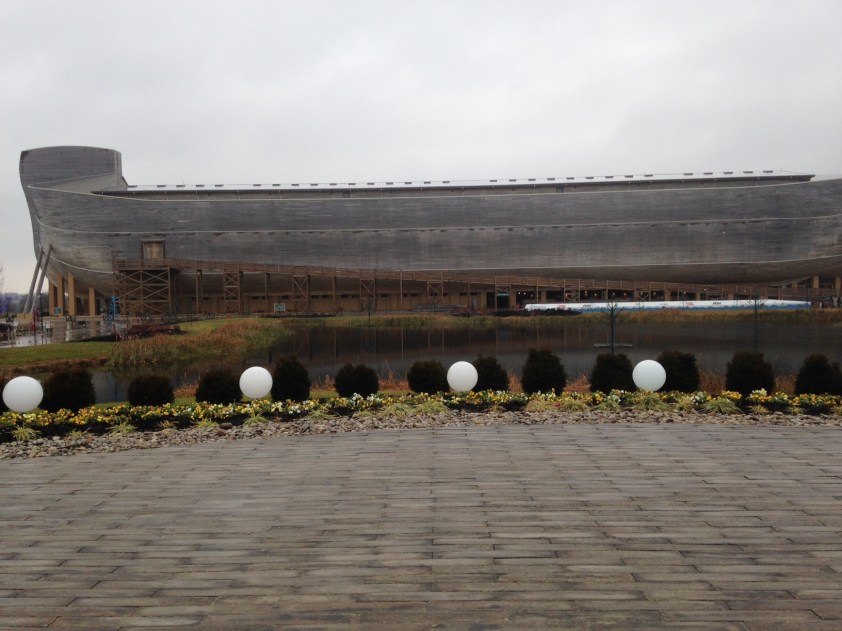
I want to encourage everyone who reads this blog to take these warnings seriously. I would also like to encourage you to visit the Answers in Genesis replica of Noah’s Ark (Ark Encounter). If you are already a follower of Jesus, you will find this museum a real faith-builder, and if you are not a believer, you will find answers to many of the questions that have made you doubt the historicity of the universal flood and the record of Noah and the ark.

I have also included 3 of the main passages of Scripture I used to write this blog:

  • Matthew 24:37-44 But as the days of Noah were, so shall also the coming of the Son of man be. For as in the days that were before the flood they were eating and drinking, marrying and giving in marriage, until the day that Noah entered into the ark, and knew not until the flood came, and took them all away; so shall also the coming of the Son of man be. Then two shall be in the field; one shall be taken, and the other left. Two will be grinding at the mill; one shall be taken, and the other left. Watch therefore: for you know not what hour your Lord comes. But know this, that if the master of the house had known in what hour the thief would come, he would have watched, and would not have allowed his house to be broken into. Therefore be also ready: for in such an hour as you think not, the Son of man will come.
  • 2 Peter 2:4,5 For if God did not spare the angels who sinned, but cast them down to hell and delivered them into chains of darkness, to be reserved for judgment: and did not spare the ancient world, but saved Noah, one of eight people, a preacher of righteousness, bringing in the flood on the world of the ungodly.
  • 2 Peter 3:3-10 Knowing this first, that there shall come in the last days mockers, walking after their own lusts, and saying, Where is the promise of His coming? for since the fathers died, all things continue as they were from the beginning of creation. For this they are willingly ignorant, that by the word of God the heavens were of old, and the earth standing out of the water and in the water: by which the world that then existed perished, being flooded with water: but the heavens and the earth which are now, by the same word are kept in store, reserved unto fire until the day of judgment and destruction of ungodly men. But, beloved, be not ignorant of this one thing, that one day with the Lord is as a thousand years, and a thousand years is as one day. The Lord is not slack concerning His promise, as some men count slackness; but is longsuffering toward us, not willing that any should perish, but that all should come to repentance. But the day of the Lord will come as a thief in the night, in which the heavens will pass away with a great noise, and the elements will melt with fervent heat; both the earth and the works that are in it will be burned up.

Check out this post from a fellow blogger: http://roadlesstraveledtours.com/our-help-in-time-of-trouble/

The Hour That Changes the World

Many years ago I came across this book on prayer, and during the times that I followed Dick Eastman’s simple method of praying, I found that my daily prayer walk with the Lord was much deeper. Well, I recently came across this book again, and I realized that I had forgotten some of things that I had learned about prayer from this book. The prayer plan outlined in this book was not necessarily meant to be the one and only method for praying, but it simply contains suggestions based on Scripture that have helped many Christians in the United States (and around the world) revitalize their prayer lives. In fact, Joni Eareckson Tada has written the following about it: “Full of biblical insights about prayer, packed with testimonies of prayer warriors from years past, brimming with practical suggestions that will help you carve out a purposeful time of praise and intercession, Dick Eastman’s book is arguably the most significant book on prayer written in modern times.”

I want to challenge you to spend at least one hour of prayer using these twelve points of focus. Although you can vary the length of time that you spend on each part, including some of all of them is important. Everyone’s life is somewhat different depending upon what stage of life we are in; for various reasons, some may honestly find it almost impossible to spend an hour in prayer everyday, but I would guess that for most of us that an hour is not an impossible goal. And of course, you don’t have to limit your prayer to only one hour a day! God has told us that if we seek Him, we will find Him, when we search for Him with all of our heart (Jeremiah 29:130). Also, in 1 Thessalonians 5:17, we are told to pray without ceasing. Although we can be in a prayerful state of mind while talking to God about everything throughout the day, having longer, and more focused prayer is also very important. We see different times in the gospels that even Jesus spent long periods of time praying. In Matthew 26:40, while in the garden on the Mount of Olives, Jesus pleaded with the disciples to pray with Him for one hour (before He was betrayed by Judas Iscariot, condemned to death on the cross, bearing the sins of the world, and separated from God the Father).

The following is a very brief summary of what is included in the prayer plan from The Hour That Changes the World:

PRAISE-(Psalm 63:3, Hebrews 13:15, Matthew 6:9b)- the aspect of prayer which vocally esteems God for His virtues and accomplishments.

WAITING-(Psalm37:7, Isaiah 40:31, Lamentations 3:25)- being quiet in God’s presence, and simply taking time to love God and to let God love you.

CONFESSION-(Psalm139:23, 1 John 1:9)- since sin is one of the greatest roadblocks to answered prayer (Psalm 66:18), we need to take time to confess any sin in our lives.

THE WORD-(2 Timothy 3:16, Psalm 19:7,8)- bringing God’s Word into our prayer, we are opening our eyes to new possibilities as we simply read sections of His Word.

INTERCESSION-(1Timothy 2:1,2, Psalm 2:8, Matthew 9:37, 38)- center your intercession on our lost and dying world.

PETITION-Matthew 6:11, Matthew 7:7, Philippians 4:6b, James 4:2)- this aspect concerns our personal needs.

THE WORD-(Jeremiah 23:29, 2 Samuel 22:31, Numbers 23:19)- now pray God’s will. You can never pray out of God’s will when you pray God’s Word back to Him.

THANKSGIVING-(Psalm 100:4, Philippians 4d:6)- recognizes God for specific things that He has done, while praise recognizes God for who He is.

SINGING-(Psalm 100:2, Ephesians 5:19, Psalm 144:9)- learn the beauty of singing a “new” song unto God during your prayer.

MEDITATION-(Joshua 1:8, Psalm 77:12, Psalm 1:1,2)- to meditate is to ponder spiritual themes in reference to God.

LISTENING-(Ecclesiastes 5:2, 1 Kings 19:11, 12)- we must take time to listen for specific direction from God, not just to talk.

PRAISE-(Matthew 6:13, Psalm 100:4, Psalm 150)- when our prayer moves toward its conclusion, we focus our praise on His omnipotence (power), His omniscience (knowledge), and His omnipresence (presence everywhere).

More Tips on Aging Well

As I was going through my files, I found some more tips on aging well that I hope are helpful. First, be sure to spend time in God’s Word, praying, and participating in the spiritual activities in your church that give you godly fellowship and socialization. Then, always find reasons to be thankful (1 Thessalonians 5:18). If you feel anxious, upset, or frustrated, take the time to write down things that you are thankful for. Expressing gratitude can help you to deal with your emotions, and may prevent or reduce depression. People who are thankful tend to be physically healthier as well. Expressing gratitude often makes you feel more positive and optimistic, and saying thank you to others makes them feel appreciated and special, which will also help mend and build relationships. Being thankful and keeping a gratitude journal may help you to sleep better at night. By focusing on what you are thankful for and by keeping things in perspective rather than feeling sorry for yourself, you may find that you have a better self-concept and are more sensitive to the needs of others. As a result, others will enjoy being around you, and you will realize that you still have a purpose in life.

The following is a poem about an old man who still found purpose in his life:

“An old man going a lone highway, came at the evening, cold and gray,
to a chasm, vast and deep and wide, no bridge spanned from side to side.
The old man crossed in the twilight dim; the swollen stream had no fear for him.
But he turned when safe on the other side and built a bridge to span the tide.
“Old man”, said a fellow pilgrim near, “you’re wasting your time with building here.
You never again will pass this way; your journey will end with the close of day.
You have crossed the chasm, deep and wide. Why build you this bridge at eventide?”
The builder lifted his old gray head, “Good friend, in the way I’ve come,” he said,
“There followeth after me today a youth whose feet must pass this way.
This stream that has been as nought to me to the fair-haired youth might a pitfall be.
He, too, must cross in the twilight dim; Good friend, I’m building this bridge for him.”

(-Author unknown)

Next, take care of your physical body. Get plenty of sleep. Eat healthy, nutritious foods, and take supplements as needed. Maintain a healthy body weight, too. Many seniors eat out too often and ignore the fact that restaurant foods have a lot of added sugar and salt, and can lead to obesity and other health problems. Stay physically active by walking, swimming, or biking daily, and by participating in sports in which you are less likely to get injured. Older people don’t drink enough, so be sure to stay hydrated by drinking plenty of water; and of course, avoid alcohol beverages and smoking.

Following the above tips will help limit the medications you are on, and by taking fewer trips to the doctors and hospital, you may find that you are not getting sick as often. Also, prepare the environment of your home in ways to avoid accidents. Putting a seat in the shower and having a non-slip surface on the floor of the shower will help prevent slipping and falling. Staying safe can also mean don’t become a victim of crime in your home or while out and about. Without becoming paranoid, you can learn to be more cautious; and by being aware of your surroundings and the people you see close by, you may avoid being robbed.

Here are some other ways to maintain a positive attitude, no matter what. Try to look at a glass as being “half full” rather than “half empty”. Be flexible, and embrace beneficial changes. Keep a sense of humor. Ask for help when you need it, and offer help when others need it. Don’t watch a lot of television or spend too much time on the computer. Do some other type of activity that you enjoy every day (reading, sewing, crossword puzzles, jigsaw puzzles, making or building something, birdwatching, etc.). Appreciate the simple things around you, like sunsets and rainbows in the sky, flowers, babies, and animals. Staying involved in life, and maintaining a positive attitude as you grow old, will keep you and everyone around you much happier. And always remember, if you are a follower of Christ, the best is yet to come!

Sandcastle Dreams

Psalm 61:1-3 Hear my cry, O God; attend unto my prayer. From the end of the earth will I cry unto thee, when my heart is overwhelmed: lead me to the rock that is higher than I. For you have been a shelter for me, and a strong tower from the enemy.

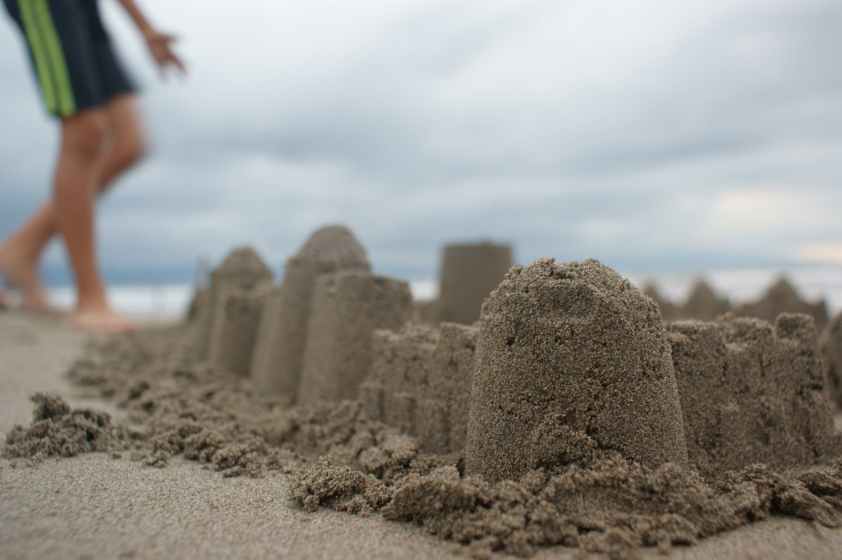
Sometimes I have felt utterly desperate – like the world is coming to an end. My heart is overwhelmed… I have been following after worthless things – flammable goods – investing in a beautiful sand castle, complete with a moat, pillars, and spires. My moat is full of salt water which cannot quench my thirst. Nothing can grow inside the heart of my sand castle. But it is beautiful – at least that’s what the world tells me. I stand on my drawbridge, arms crossed.

Then the waves come. First small waves, refilling my moat. I go into my sand castle, to the top of the wall, to keep an anxious eye on the waves. They can’t reach me up here…, but wait! There is a vibration under me! I peer over the wall. Oh no! The walls that I have so carefully poured my heart into are eroding. The tide’s greedy hand is shaving away years of my hard work. Then the wall that I am standing on starts leaning precariously toward the sea and another huge wave comes. It is bigger even than my whole castle. It engulfs me. My once proud castle no longer knows which way is up nor which way is down, and neither do I. Sand is in my eyes; saltwater stings my face. My life’s work has vanished.

Suddenly, I am thrown against a hard surface. The air in my lungs leaves me. I reach out and try to grab the object – my hands are rewarded as I grasp onto it. It is a large rock. The waves pull at me violently, but I am determined to hang onto it. I climb to the highest point on this rock. The waves are far below me now, turning and twisting violently. I no longer fear them now, because I am standing on the Rock that is higher than I, abiding on this solid foundation, singing a song of praise.

I no longer miss my sand castle!

Put on the Armor of God in order to Stand in the Evil Day

In order to live a victorious life in Christ, we must first recognize that there is a serious spiritual war going on around us all the time. The battles in this war are for the hearts, minds, and souls of humanity. Since Satan knows that his time is short, he wants to take as many people to hell with him as he can. This never-ending war will continue until the Lord’s return, and if we want to be the “peculiar treasure” of God that shines in this dark world, we must “be strong in the Lord and in the power of His might” (Eph. 6:10).

Too often Christians get busy and distracted by temporary things rather than keeping our minds focused on eternity. We forget that “our adversary, the devil, as a roaring lion, walks about seeking whom he may devour” (1 Peter 5:8) The Bible tells us to resist him. James 4:7 says to “submit yourselves therefore to God. Resist the devil, and he will flee from you,” and verse 8 says if we draw nigh to God that He will draw nigh to us.

I’m not sure that adults take this passage in Ephesians 6 seriously enough. These verses are often used in children’s Sunday School classes and in Vacation Bible School, because children enjoy coloring and making the armor pieces. That’s great, but adults need to recognize the urgency of putting on this armor, too. We need to stand against the “wiles of the devil” (verse 11), because Satan and his demons have carefully devised schemes and tactics that they use against people, and they have had many years to practice and improve their strategies.

We are not wrestling against flesh and blood, but against these wicked spiritual beings, so we should realize that we cannot fight these battles in the flesh. We must with God’s help use the provisions of this armor, relying upon His power in order to stand strong against the enemy. This is not a one time attack. These attacks will come again and again, so we must stay watchful and alert.

I will try to summarize the six pieces of armor (see Ephesians 6:11-18) that we must put on. First, we have the belt of truth. Knowing the truth of God’s Word will keep us from the deception of false teachers and cults. The breastplate of righteousness represents the godly character that results from obeying the truth that we know. Shoes that are the preparation of the gospel of peace remind us that we are to be peacemakers just as Christ tell us in Matthew 5:9. In order to share the gospel in this troubled world, we need to be at peace with God, others, and with ourself. Completely trusting God and all of His Word is like a shield, allowing us to quench the fiery darts of the enemy. The helmet of salvation reminds us of the hope we have because we have believed what Christ’s death on the cross did for us, repented of our sins, and we now live as “new creatures in Christ”. The sword of the Spirit is the offensive weapon that we use to fight the enemy. After Jesus spent those 40 days in the wilderness, the devil came to tempt Him, and in response to each temptation, Jesus spoke truths from the Word of God until the devil departed. That means that we must read and know His Word in order to use this weapon well. And finally remember to watch and pray always for ourselves, and for all believers, with the guidance of the Holy Spirit.